

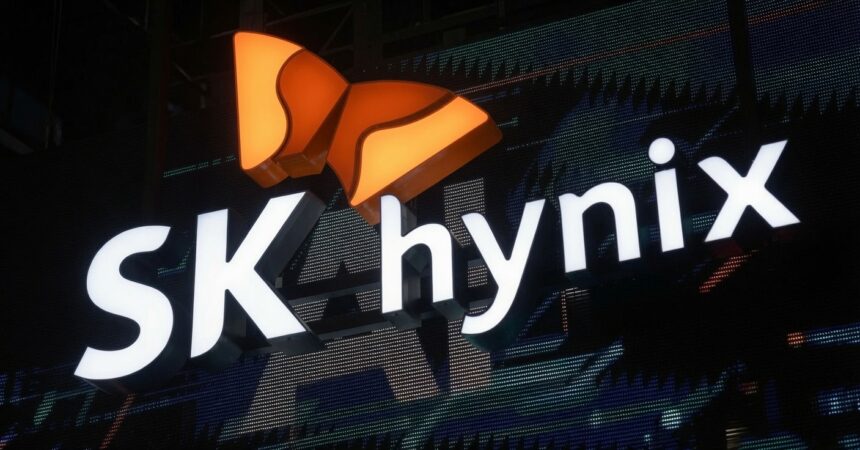
SK Hynix began trading on the Nasdaq on Friday after raising $26.5 billion in the largest U.S. share sale ever completed by a foreign company, as investor demand for exposure to the South Korean chipmaker’s AI memory business ran at more than seven times the available supply.
The offering priced 177.9 million American depositary receipts at $149 each, surpassing the $25 billion Alibaba raised in its 2014 U.S. listing. Shares opened at $170, a 14% gain over the offering price, valuing the company at approximately $1.27 trillion and placing it 11th by market capitalization among U.S.-listed companies, above Eli Lilly and below Tesla. The ADRs traded Friday under the temporary ticker SKHYV before shifting to the permanent ticker SKHY the following week.
SK Hynix holds a 58% share of the global market for high-bandwidth memory, the specialized chip technology that sits alongside AI accelerators from companies including Nvidia and AMD to move data at the speeds AI processing requires. The company’s first-quarter 2026 revenue reached 52.58 trillion won, equivalent to about $38.1 billion, a 198% increase from the same period a year earlier, with net profit margin rising to 77% from 46%, driven almost entirely by HBM sales.
SK Group Chairman Chey Tae-won told CNBC that demand for the company’s memory chips shows no signs of slowing as AI systems expand beyond software into physical applications. “The demand is enormous, exponentially, so I don’t really see” signs of a slowdown, Chey said. He added that AI agents and physical robots will require substantially more memory chips going forward.
Nearly all of the proceeds are earmarked for capacity expansion, with the company building a $4 billion advanced packaging facility in West Lafayette, Indiana, alongside a far larger $390 billion cluster of chip fabrication plants in Yongin, South Korea. SK Hynix said it plans to commit more than $720 billion in capital investment over the coming years, the majority of it in South Korea.
The Nasdaq listing, rather than a New York Stock Exchange listing, was a choice tied to Nasdaq 100 index inclusion, which analysts widely expect during the index’s routine rebalancing in December. Korea Investment & Securities estimated that resulting passive fund purchases could account for roughly 2% of outstanding ADR shares. Cornerstone investors including Baillie Gifford, Coatue Management and Situational Awareness Partners were allocated approximately $5 billion of the offering, according to Bloomberg.
Some analysts have flagged the memory industry’s history of boom-and-bust cycles as a risk to the company’s current valuation. Daniel Newman, chief executive of the Futurum Group, said memory chip names tend to run hot during periods of high demand before falling hard once supply catches up, though he said memory stocks could still look inexpensive if AI demand remains elevated. Morningstar analyst Jing Jie Yu said a broader recovery in memory supply expected in 2027 and 2028 could weaken pricing power industrywide.
SK Hynix’s Seoul-listed shares have risen 634% over the past year despite a roughly 25% pullback from a late June record high, reflecting what analysts described as investor uncertainty over how long the current AI-driven memory shortage will last. The company’s Nasdaq debut follows SpaceX’s IPO last month, which remains the only U.S. listing to raise more capital this year.