


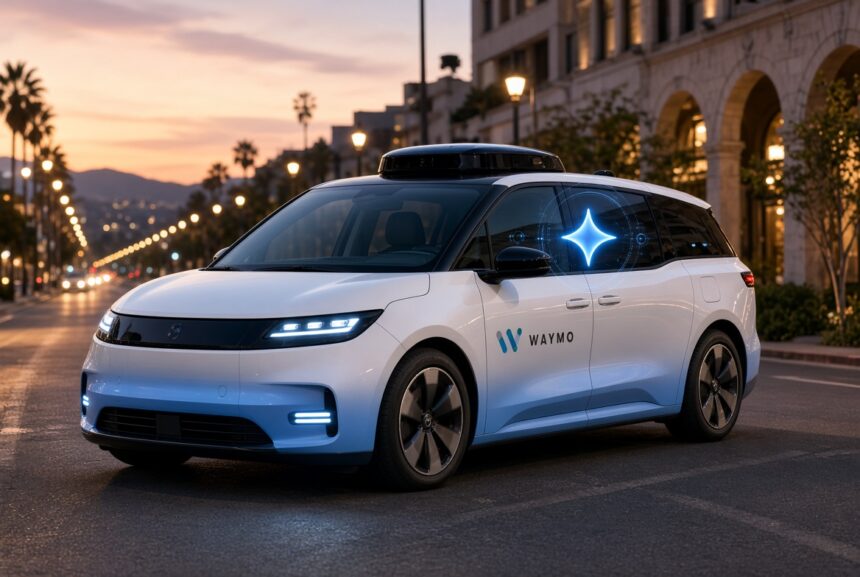
Waymo Ojai robotaxi is now available to all riders in San Francisco, Phoenix and Los Angeles, as the Alphabet-owned company expands access to its cheaper next-generation vehicle and adds Google’s Gemini as an in-cabin AI assistant.The purpose-built electric minivan was previously limited to select riders. Customers in the three cities can now be matched with an Ojai when they request a ride. Once the fleet is large enough, riders will be able to choose between the Ojai and Waymo’s existing Jaguar I-Pace robotaxis.
Previously, the minivan-style electric vehicles had been limited to select riders and early-access programs after first carrying passengers in May and June. Once the fleet grows large enough, riders will be able to choose between the Ojai and Waymo’s existing Jaguar I-Pace robotaxis.Waymo currently has about 300 Ojai vehicles in its commercial fleet.
The company plans to introduce the model in Denver, Las Vegas and San Diego later this year, with further cities to follow.The Ojai represents a shift toward vehicles built specifically for robotaxi service rather than modified production cars. Chinese automaker Zeekr manufactures the base vehicle in Ningbo, Zhejiang, on its SEA-M platform.
The chassis and body are then shipped to Waymo’s factory in Mesa, Arizona, where the company installs its sensors, computers and software. The result is a boxy, spacious electric minivan with flat floors that can accommodate wheelchairs, large trunks, elevator-style doors and an interior Waymo has compared to a modern living room.
The vehicle runs on Waymo’s sixth-generation Driver system. Company officials say the new hardware uses fewer but higher-resolution cameras and lidar units, improving perception while supporting operations in more varied weather, including snow. The modular design is intended to work across different vehicle types and help lower the cost of building, operating and maintaining the fleet compared with the Jaguar I-Pace models that have formed the backbone of Waymo’s service.
Alongside the public launch, Waymo rolled out Google’s Gemini as an in-car assistant. Riders can activate Gemini by tapping an on-screen icon or using voice commands. The system handles cabin controls such as adjusting the air conditioning, provides journey information, answers general knowledge questions and offers details about the Waymo service itself.
It can also process a request to pull over. Gemini operates separately from the autonomous driving system and does not control the vehicle’s movement on the road.Waymo also introduced a redesigned rider interface intended to make the experience clearer and more intuitive.
The expansion comes as Waymo accelerates growth. California regulators recently approved a major broadening of the company’s operating area, covering additional counties from the San Francisco region south toward San Diego and inland toward Sacramento. Waymo already operates in multiple U.S. cities and continues to compete with emerging players, including Zoox and efforts by traditional ride-hailing companies to deploy their own autonomous fleets.Industry observers note that purpose-built vehicles like the Ojai are central to the economics of scaling robotaxi services.
Modified luxury SUVs proved capable for early commercial operations but carried higher per-unit costs. A cheaper platform with higher production potential is viewed as necessary for Waymo to expand volume while remaining competitive on price with human-driven services.Waymo has not released detailed public pricing comparisons between Ojai and I-Pace rides.
Independent analyses of overall Waymo fares in recent months have shown the service narrowing the gap with Uber and Lyft in some markets, particularly on longer trips, though dynamic pricing still varies by time, demand and distance.
The company is scaling production capacity at its Mesa facility with the goal of supporting tens of thousands of vehicles annually over time. Analysts tracking vehicle shipments have estimated that Waymo could have several thousand Ojais in the United States by the end of 2026 if current trends continue.
Safety remains the stated priority. Waymo emphasizes gradual, monitored rollouts in new areas and continues to publish data on its autonomous operations. The sixth-generation system and purpose-built design are presented as steps toward more robust performance across a wider range of conditions and use cases.For riders in San Francisco, Phoenix and Los Angeles, the immediate change is simple: requesting a Waymo ride now carries a chance of arriving in the larger, more spacious Ojai rather than the familiar Jaguar.
As more vehicles enter service, the company expects the new model to become a core part of the everyday fleet.The launch underscores the accelerating shift from experimental autonomous rides to higher-volume commercial service, with hardware costs, passenger experience and artificial intelligence features all playing central roles in the next phase of robotaxi competition.