

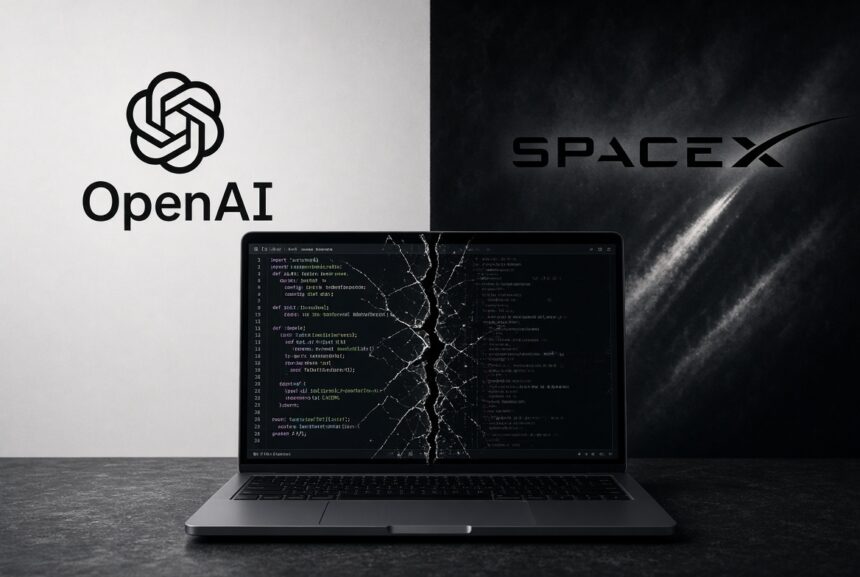
OpenAI is ending its partnership with Cursor on November 12. The official reason is trust. The thing that actually changed is the owner.
I’ll be honest with you: OpenAI ending its partnership with Cursor stopped me in a way a normal vendor memo does not. This was not a model getting worse. This was not a pricing fight. This was a four-year relationship getting killed because the customer got a new parent.
I would not call Cursor a side project. It is one of the tools serious developers actually live in. Proof points, users, revenue, a $60 billion all-stock sale to SpaceX that closed August 14. And then, two weeks later, OpenAI tells SpaceX the GPT tap is getting shut off on November 12.
OpenAI says the decision was incredibly tough. They also say they cannot be confident SpaceX will use the models inside the terms of service, based on experience with Elon Musk’s companies violating contracts. They point at X after the Twitter deal. They point at Musk admitting under oath this year that xAI violated OpenAI’s terms. xAI is now inside SpaceX too. The Cursor contract had a change-of-control window. OpenAI used the maximum notice that window allowed. Cursor does not get future models. That includes Astra.
Musk’s response was that he couldn’t care less.
Cursor CEO Michael Truell tried to keep the room from catching fire. OpenAI models are about 5% of Cursor traffic, he said. They are talking. Cursor was one of the first OpenAI users. They trusted the platform to be neutral infrastructure. That 5% is his number, not an audit.
Reuters reported that Anthropic said it would increase compute support for Claude models in Cursor. Whether that is a rescue or just a company walking through an open door is a separate question.
As a founder, my reaction was complicated because I could agree with both sides. I do not think developers are overreacting if the workbench they trusted just became a factional object. I also do not think OpenAI is required to keep supplying models to a surface newly owned by the person who spent years trying to take them apart in court. Musk sought about $150 billion from OpenAI. A jury rejected that case in May. The lawsuit is not the current legal threat. The grudge clearly survived the verdict.
Long story short, OpenAI ending its partnership with Cursor is what happens when “we sell models to everyone” collides with “we do not trust that buyer’s owner.” Nothing about the IDE itself had to change for the product to feel less trustworthy.
Before you treat this as either a noble safety stand or a petty celebrity feud, run four tests.
1. The Evidence Test: Is This Proving a Safety Problem, or Illustrating a Grudge?
There is a fine line between “we cannot deploy frontier models into an environment we do not trust” and “we had a clause, the owner changed, and we used it.”
OpenAI is allowed to care about terms of service. If X broke a contract and Musk admitted xAI violated similar terms, that is not nothing. It is also not a new Cursor incident. The models were acceptable in the same product last month. The evidence that changed is the cap table.
Ask the simple question. Is OpenAI ending its partnership with Cursor because of how Cursor uses the models, or because of who now owns Cursor? If the image they are painting is “safety at scale,” the proof still has to be about Cursor’s deployment, not only about Musk’s résumé.
You do not have to pretend every cancellation is a war crime. You should think carefully before treating a change-of-control clause as independent proof of misuse. Those are different things.
2. The Authenticity Test: Was Neutrality Part of What Cursor Sold?
One argument I cannot stand is that developers “always knew” these labs were going to pick teams. I hate to break it to you, but a lot of people bought Cursor specifically because it felt like Switzerland. GPT one day, Claude the next, no loyalty oath required.
That neutrality was part of the value proposition. Not in a cute branding way. In the “this is why the tool exists” way. Truell said it himself: they trusted OpenAI to be neutral infrastructure.
If customers learned exactly why OpenAI is ending its partnership with Cursor, would that conflict with the reason they chose the product? For a chunk of them, yes. They thought they were buying a workbench. They got a front in somebody else’s custody fight.
There are businesses where the owner is the product. This was not supposed to be one of them.
3. The Substitution Test: What Do Developers Think Just Got Replaced?
This is the emotionally charged part, and it is less about code quality than about what people believe they were standing on.
People do not necessarily hate vendor management. They hate finding out the default model in their editor can disappear because two executives have unfinished business.
If you tell a user Claude will pick up more of the load, many will switch the dropdown and keep shipping. If you tell them GPT is leaving because SpaceX paid $60 billion and OpenAI will not bless that marriage, some will decide the whole multi-model promise was decorative.
Two questions matter:
- What do users need to know before November 12?
- Can Cursor get ahead of that judgment, or only absorb it?
“Don’t ask, don’t tell” is dead. The blog post is public. Musk replied in public. The 5% figure is public. If that 5% is casual traffic, OpenAI ending its partnership with Cursor is an inconvenience. If it is the power users, the enterprise seats, or the people writing the workflows everyone else copies, 5% is a calming statistic with sharp edges.
4. The Cost-of-Reality Test: What Was Neutrality Actually Buying?
This is the question that bruises the industry.
Can you justify keeping a model lab “open to all builders” when one of those builders gets acquired by your adversary? Can you justify selling a multi-model IDE when one of the model vendors can cancel you after a change of control?
Here are six questions that make the clean version hard:
- Did pulling GPT from Cursor materially improve safety?
- Did it simply exercise a clause that existed for this exact owner?
- Did developers get real time to adapt, or only the contract maximum dressed up as generosity?
- Did Reuters’ Anthropic note change the product, or only the press cycle?
- Did Cursor stay a platform, or did it become a SpaceXAI feature next to Grok?
- Did this make the coding market more competitive, or just more tribal?
If the answers lean toward leverage and tribes, OpenAI ending its partnership with Cursor is not a developer-protection story. It is the stack choosing sides.
Let’s shift from morals to math. SpaceX thought Cursor was worth $60 billion in stock. That price assumed the product kept being the place where serious people write software with the best available models. OpenAI assumed it could sell into a customer it liked and walk if the customer’s owner changed. Both assumptions just met in public.
Money spent pretending model access is neutral plumbing cannot also be spent building a company on top of that plumbing.
It’s not Altman versus Musk. It’s whether the workbench stays a workbench.
At the end of the day, the thing users can hold everyone to is simple. If you sell a workbench, keep it a workbench. If you sell a model under terms, enforce the terms. If you cannot do both at once, stop advertising both at once.
I am not suggesting OpenAI had to keep feeding GPT into a Musk-owned surface after years of legal and personal warfare. I am not suggesting Cursor users are being dramatic. OpenAI ending its partnership with Cursor is what happens when platform and rival stop being separate jobs.
November 12 is the date. Astra is the model that will not show up. Claude is the obvious substitute. Grok is the house brand waiting in the wings.
The developers did not start this. They still have to pick a default.