


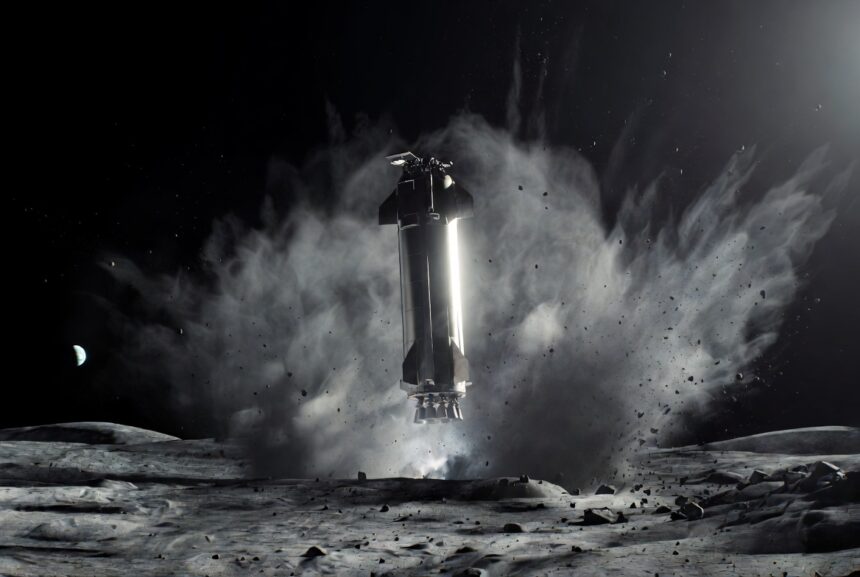
A spent upper stage from a SpaceX Falcon 9 rocket crashed into the Moon on Wednesday near Einstein Crater, creating a new impact site after drifting in space for more than a year.
The roughly 4-ton (about 8,800-pound), 45-foot-long stage struck the lunar surface at approximately 5,400 mph (8,700 km/h) around 6:35 a.m. UTC (2:35 a.m. EDT).
The object, cataloged as 2025-010D, launched on Jan. 15, 2025, carrying Firefly Aerospace’s Blue Ghost and ispace’s Hakuto-R Mission 2 lunar landers under NASA’s Commercial Lunar Payload Services program.
The booster stage returned to Earth as planned after launch. The upper stage remained in a high orbit that eventually intersected the Moon’s path due to gravitational forces and other perturbations. Astronomers had tracked the trajectory for months and predicted the impact with high confidence.
NASA’s Center for Near-Earth Object Studies confirmed a 100% probability of collision. Scientists confirmed the impact through detections of sodium and lithium gas in a debris plume observed by the European Southern Observatory’s Very Large Telescope in Chile.
The spectral lines appeared shortly after the predicted time and lasted several minutes. South Korea’s Danuri lunar orbiter captured before-and-after images of the site using its high-resolution Lunar Terrain Imager.
The Korea AeroSpace Administration released the images Thursday, showing a newly formed dark mark and ejecta patterns near Einstein Crater on the Moon’s western limb.
The orbiter adjusted its path to observe the area and recorded topographic changes. NASA estimated the collision carved a crater roughly 60 feet across and 12 feet deep, though pre-impact models suggested dimensions of about 65 to 90 feet wide and 16 feet deep.
The event posed no danger to Earth. SpaceX said the impact was unintentional. The company noted that such outcomes can occur with objects in certain orbits and that it had coordinated with NASA on disposal options. The first stage of the Falcon 9 was recovered normally.
The crash provides scientists a rare, well-documented case of a human-made object striking the Moon, allowing study of crater formation, ejecta distribution and lunar surface properties. NASA’s Lunar Reconnaissance Orbiter is expected to gather additional high-resolution imagery of the site.