

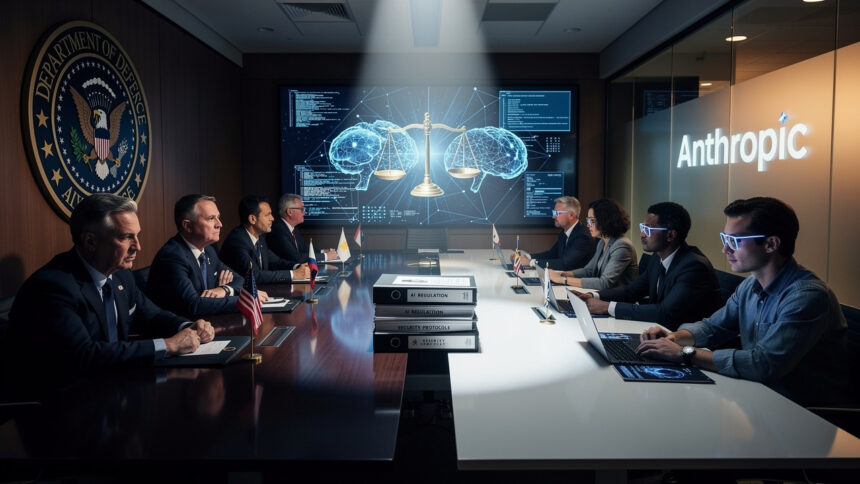
Newly unsealed court emails show a Pentagon official told Anthropic chief executive Dario Amodei that contract talks were “very close” to a resolution, one day after the Department of Defense had formally designated the AI company a supply-chain risk, and before Anthropic had even been notified of that designation.
The emails, filed in the U.S. District Court for the Northern District of California and first reported by The Wall Street Journal, trace months of negotiations between Amodei and Emil Michael, the undersecretary of defense for research and engineering; over how the Pentagon could use Anthropic’s Claude models.
According to the correspondence, the dispute centered not on access to the technology itself, but on two specific restrictions Anthropic sought to maintain which includes a ban on using Claude for fully autonomous weapons systems and a ban on mass domestic surveillance.
The Pentagon, according to the emails, wanted Claude available for what it described as “all lawful uses,” a standard Anthropic argued left too much room for the said applications it was trying to rule out.
Michael reportedly told Amodei the proposed guardrails were “just not workable” and warned Anthropic had “one more chance to align on core principles” before the two sides would part ways. Michael also wrote that “there is no distinction in our world between weapons that are defensive or offensive,” according to emails published by Gizmodo.
The following day, then-Secretary of Defense Pete Hegseth designated Anthropic a supply-chain risk, a label the company has said had previously been reserved exclusively for firms tied to foreign adversaries, and never before applied to a domestic American company. Anthropic has said the designation triggered an up to six-month phase-out period requiring defense contractors and suppliers to stop working with the company.
U.S. District Judge Rita Lin, who unsealed the emails, called the timing “exceedingly difficult to square” with the government’s parallel characterization of Anthropic as a hostile national security risk, according to court filings.
Lin’s court previously found that a memorandum underpinning the supply-chain designation cited Anthropic’s “increasingly hostile manner through the press,” language Lin described as “classic illegal First Amendment retaliation,” and granted Anthropic a preliminary injunction on those grounds.
That injunction has not resolved the broader dispute. A federal appeals court in Washington, D.C., separately denied Anthropic’s request to block the Pentagon’s blacklisting while the underlying case proceeds, finding the government’s interest in managing its AI vendor relationships during “an active military conflict” outweighed Anthropic’s financial harm. As a result of the split rulings, Anthropic remains excluded from Defense Department contracts while continuing to work with other federal agencies as litigation continues.
Financial disclosures reviewed by reporters show Michael held investments in xAI, a rival AI company to Anthropic, along with stakes in other AI firms, a detail that has drawn scrutiny in coverage of the dispute, though it has not been established that those holdings influenced the Pentagon’s contract position.
Anthropic has said publicly that it supports the use of AI for lawful foreign intelligence and counterintelligence missions and does not object to partially autonomous weapons systems, the kind currently used in Ukraine. The company has drawn its line specifically at fully autonomous weapons, those that remove human decision-makers from targeting and engagement entirely, and at mass domestic surveillance, which it has said is “incompatible with democratic values.”