


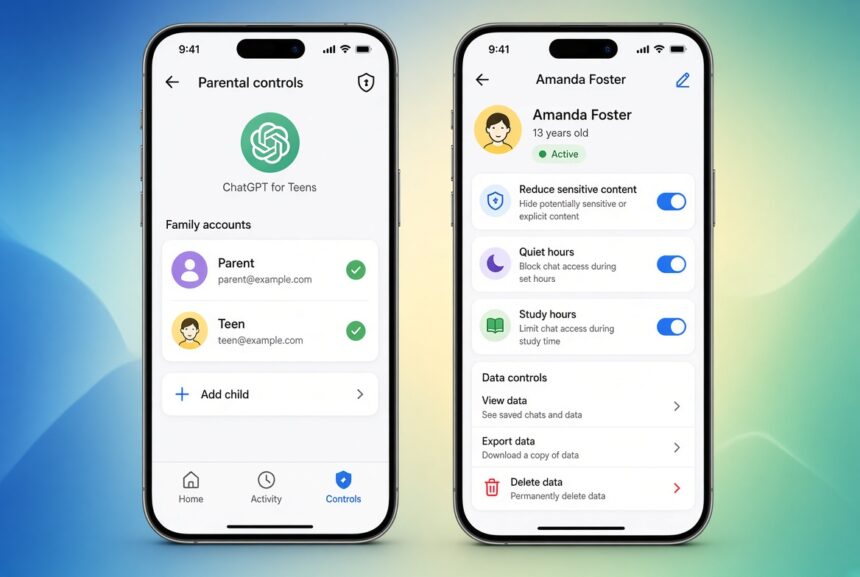
OpenAI on Tuesday began rolling out ChatGPT for Teens, a dedicated experience for users ages 13 to 17 that combines tighter content safeguards, parental controls and new features designed to steer young people toward learning rather than quick answers.The mode activates automatically when a user states they are between 13 and 17 or when OpenAI’s age-prediction system estimates the person is under 18. Children under 13 remain barred from the platform under the company’s age policy. The company said the teen experience is available on Free and paid personal ChatGPT plans, with a gradual global rollout that began Aug 18.
Full availability in Australia is expected in early September.OpenAI described ChatGPT for Teens as an experience built to help adolescents learn, think critically, deepen understanding and use artificial intelligence with greater confidence. The launch consolidates and expands protections the company has introduced over the past year, including parental controls, an updated Under-18 Model Spec, a Teen Safety Blueprint and age-prediction technology.
Learning tools take center stage
A central part of the teen experience is Study Mode. In this setting, ChatGPT uses guiding questions, step-by-step support and follow-up prompts rather than simply delivering finished answers. The company said the design draws on collaboration with teachers, learning scientists and pedagogy experts. Early internal evaluations have shown promising gains in student performance when students engage with the guided approach.New “responsible homework reminders” attempt to detect when a teen appears to be trying to shortcut an assignment.
When the system flags that behavior, it redirects the user into Study Mode for collaborative problem-solving. Teens or linked parents can also set Study Hours so that Study Mode turns on by default during designated times, aiming to turn better study habits into a routine.Additional learning features include quizzes and learning visualizations that let teens practice concepts, test understanding and see difficult ideas represented more clearly. Teen-specific onboarding and education-focused starter prompts help users begin tasks such as breaking down a topic, turning notes into a study guide or creating flashcards.OpenAI also announced a partnership with CodeAI to give students and educators tools and resources for learning how AI works, how to direct and question it, and how to use it productively.
Stronger default protections
For users under 18, ChatGPT for Teens applies age-appropriate safeguards by default. These are designed to reduce exposure to content that may be harmful or developmentally inappropriate while still allowing learning, creativity and exploration. Protections cover graphic violence, depictions of self-harm, sexual or romantic roleplay, extreme beauty ideals, viral challenges and other sensitive topics.The system is instructed more strongly not to use romantic language or terms of endearment with teens and not to suggest that it has feelings, consciousness or emotions.
OpenAI said these measures are informed by developmental science and guidance from experts, reflected in its Under-18 Model Spec.Parents and guardians who link accounts through parental controls gain additional options. They can set Quiet Hours that limit access during scheduled times, manage selected settings, and receive safety notifications in limited high-risk situations.
OpenAI is expanding those notifications to cover certain eating-disorder-related cases. Importantly, linked parents cannot read or monitor the teen’s actual conversations. Notifications share only the information needed to support the teen’s safety.Other parental tools include the ability to reduce sensitive content further, control whether conversations help improve models, manage memory use, and turn off voice mode or image generation in some cases. Linking does not give parents full surveillance of chats.
Context and mounting pressure
The launch arrives as generative AI tools face intensified scrutiny over their impact on young people. OpenAI and other chatbot makers have been the subject of lawsuits and public criticism alleging that interactions with AI contributed to mental health crises, including cases involving self-harm. Schools have struggled with students using chatbots to complete assignments, prompting debates about academic integrity and the proper role of AI in education.OpenAI has repeatedly said that teenagers are already using its tools and that the responsible path is to combine access with stronger protections rather than attempting a complete ban that would be difficult to enforce.
Company officials have pointed to research showing both risks and potential benefits when AI is used for learning and exploration under appropriate guardrails.The new teen mode builds directly on earlier steps. Parental controls were introduced in 2025 and expanded in 2026. Age-prediction technology was rolled out to help route younger users into safer experiences.
The company has also published principles intended to guide model behavior with adolescents.Industry observers note that other platforms have moved in similar directions, adding age checks, teen modes and parental tools as generative AI becomes more capable and more widely available. Critics argue that even strengthened safeguards may not fully address the risks of prolonged, private conversations with systems that can appear highly responsive and emotionally attuned. Supporters counter that well-designed tools can help teens develop critical thinking and digital literacy if they encourage active engagement rather than passive consumption of answers.
Rollout and limitations
OpenAI said feature availability may vary by region. The company is starting the rollout globally and expects broader access in coming weeks. Parents must still go through an invitation process to link accounts: a parent sends an invite by email or phone, the teen accepts, and the parent can then manage settings from their own account.The company has not released detailed metrics on how many teen accounts currently exist or how quickly the new mode is expected to cover the majority of under-18 users. It also has not provided independent third-party evaluations of the effectiveness of the new homework-detection or Study Mode features at scale.Privacy remains a point of attention. While parental controls do not grant access to conversation content, OpenAI continues to face questions about data use, model training and the long-term implications of young people interacting extensively with AI systems. Defaults around improving the model with teen data can be adjusted by parents.
Broader implications
ChatGPT for Teens reflects a larger industry shift. As large language models move from novelty to everyday tools, companies are under pressure to demonstrate that they can serve younger users responsibly. Education systems are simultaneously experimenting with AI while trying to preserve genuine learning.
Parents are seeking practical controls without complete surveillance.OpenAI’s approach emphasizes learning scaffolding, default content limits and optional family tools rather than pure restriction.
Whether those measures meaningfully reduce risks while preserving benefits will depend on real-world use, independent research and continued iteration.The company said it will keep refining the experience based on feedback from teens, parents, educators and safety experts. For now, the launch marks the most comprehensive attempt yet by a major AI provider to create a distinct, age-appropriate version of a widely used chatbot.