


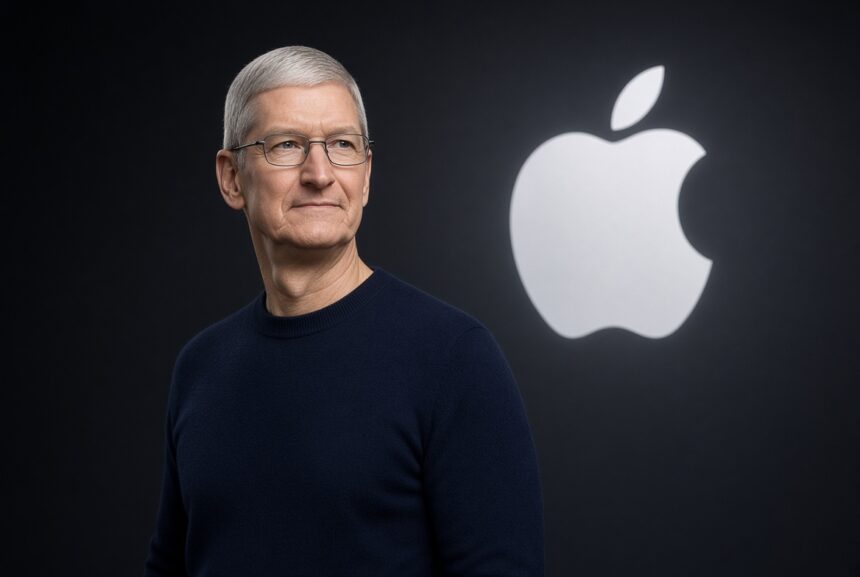
Tim Cook’s last day as Apple CEO is August 31. John Ternus takes over on September 1. Nine days later, he has to walk onstage and look like the future.
I’ll be honest with you: Tim Cook last day as Apple CEO should have felt like the end of something. Instead it felt like watching a company change the name on the door while the September event was already on the calendar.
Cook’s last day in the job is August 31, 2026. On September 1, John Ternus becomes CEO. Cook stays as executive chairman, which is a polite way of saying he keeps the rooms Apple cannot afford to fumble: Washington, Beijing, the parts of the job that are diplomacy in a company hoodie. Ternus is 50. He joined in 2001. He ran hardware engineering. He is the engineer. Cook was the operator who took Steve Jobs’s company and turned it into a $4 trillion supply-chain-and-services machine.
Then September 9 arrives. “Surprise and shine.” 10 a.m. Pacific. First keynote of the Ternus era. The rumor stack is not shy: iPhone 18 Pro, iPhone 18 Pro Max, and Apple’s first foldable, talked about as iPhone Ultra. Watch Series 12 and Watch Ultra 4 are expected to come along for the ride. The regular iPhone 18 is reportedly sliding to spring 2027, which would split the annual iPhone cycle in two.
I would not call Apple a company in crisis. Followers, cash, proof points, the most watched product launch on earth. And yet the AI years have left it looking late in public, and that lag is now somebody else’s first week.
As a founder, my reaction was complicated because I could agree with both sides. I do not think Cook failed. Revenue more than quadrupled. Services became a $100 billion-plus business. The App Store became a political object and a cash register. I also do not think “we shipped another excellent Pro phone” is going to feel like a new era if Siri is still the punchline.
Long story short, Tim Cook last day as Apple CEO is not a retirement roast. It is Apple betting the next decade still belongs to objects, and that those objects can make the company look current without turning into a chatbot vendor with better aluminum.
Before you write this as either a rebirth or a nothing-burger, run four tests.
1. The Evidence Test: Is September 9 Proving a New Apple, or Illustrating One?
There is a fine line between a keynote that demonstrates a company and a keynote that substitutes for one.
A foldable on a slide is illustration. A foldable you can preorder around September 12 and hold around September 19 is evidence. Book-style. Outer screen in the 5.3 to 5.5-inch range. Inner screen around 7.6 to 7.8. Titanium talk. Almost-no-crease talk. Price talk from $2,000 to $2,500. IDC has floated 10 million units in year one. That is not iPhone-volume. It is enough volume to stop the sentence “Apple has no answer.”
The Pro phones are the proof Apple can still print money. A20 Pro on 2nm. Apple’s own C2 modem, if it actually ships. Camera work. Smaller Dynamic Island. Price hikes already being floated. That is how you fund the science project.
The missing base iPhone 18 is the tell. If the volume model moves to spring, September stops being “here is this year’s iPhone” and becomes “here is the expensive iPhone and the experiment.” Same company. Completely different event.
Ask the simple question. Is this hardware functioning as evidence that Apple still invents the object people wait for, or as a creative way to change the subject from AI?
2. The Authenticity Test: What Was Cook Actually Selling?
One argument I cannot stand is that customers “always wanted Apple to be more like OpenAI.” I hate to break it to you, but a lot of people paid Apple money specifically because it did not feel like a lab demo. They bought the thing that worked, synced, and showed up in the store on Tuesday.
That reliability was part of the value proposition. Cook sold competence. Jobs sold invention. Ternus has to sell both in one hour without looking like he is doing impressions.
If customers learned exactly how this transition works — hardware CEO, political chairman, first week defined by a foldable — would that conflict with why they chose Apple? For some, no. They wanted a new shape. For others, yes. They wanted the company that does not flinch, and a $2,500 hinge with an asterisk is a flinch wearing product marketing.
Human judgment is still what they think they are buying at the top of the lineup. A CEO who is “obsessed with every detail” only helps if the details include the feeling, not just the tolerances.
3. The Substitution Test: What Do People Think This CEO Change Replaced?
This is the emotionally charged part, and it has almost nothing to do with who sits in which office.
People do not necessarily hate succession. They hate finding out the thing they loved got swapped for a press cycle.
If you tell a customer Tim Cook last day as Apple CEO just means a hardware lifer is now in charge of phones they already like, most people will not organize a boycott. If you tell them Cook left because Apple was late to AI and the foldable is the apology, their reaction changes. They will judge the hinge as a personality test.
Two questions matter:
- What do customers need to know on September 9?
- Can Ternus get ahead of that judgment, or only walk into it?
“Don’t ask, don’t tell” does not work when the entire industry has spent two years asking why Apple’s software feels behind. If the event pretends the only story is cameras and creases, the comments will write the AI paragraph for them.
4. The Cost-of-Reality Test: What Is Apple Paying to Stay Apple?
This is the question that bruises Cupertino.
Can they justify another year of being the last grown-up hardware company while everyone else bundles a model lab into the OS? Can they justify a $2,500 foldable if the software inside it still feels like last year’s Siri with better lighting?
Here are six questions that make the victory lap hard:
- Did the CEO change materially improve the AI story, or only the org chart?
- Did September 9 portray the product more honestly, or more theatrically?
- Did a new shape produce a better reason to upgrade than a faster chip?
- Did splitting the iPhone cycle create more revenue, or more confusion?
- Did Cook remaining executive chairman reinforce continuity, or advertise that Ternus cannot do the political job yet?
- Did custom silicon and Srouji’s promotion actually move the AI needle, or only protect Apple’s favorite narrative?
If the answers are thin, Apple is spending a succession year protecting the old cadence and calling it vision.
Let’s shift from morals to math. Cook’s Apple got paid for shipping hundreds of millions of desirable objects and then renting software on top. Ternus’s Apple has to do that while the competitive set is selling an assistant as the product. The foldable is a hardware answer to a software lag. Sometimes that works. The original iPhone was a hardware answer too.
Money spent pretending the iPhone event can still settle every argument cannot also be spent fixing Siri. They have to pick.
It’s not Cook versus Ternus. It’s whether the next object still feels inevitable.
At the end of the day, the thing customers can hold Apple to is simple. Ship what you previewed. Make it feel like an iPhone. Do not ask people to clap for a transition if the product is doing all the explaining.
I am not suggesting Cook should have stayed until Apple won the chatbot war. I am not suggesting Ternus is a downgrade because he knows hinges better than hearings. Tim Cook last day as Apple CEO just makes the next 10 days unusually honest.
Either September 9 looks like a company that still knows how to make an object people wait in line for, or it looks like a very rich organization changing the nameplate while the same phone walks out in a new coat.
Cook already did the operational decade. Ternus has to make the next object feel like it was worth handing him the building.
Rank Math
Focus keyphrase: Tim Cook last day as Apple CEO
SEO title: Tim Cook Last Day as Apple CEO Hands Apple to a Hardware Guy
Permalink: /tim-cook-last-day-as-apple-ceo
SEO description: Tim Cook last day as Apple CEO is Aug. 31. John Ternus starts Sept. 1, then faces the Sept. 9 foldable iPhone event. Here is what changes for Apple next.