


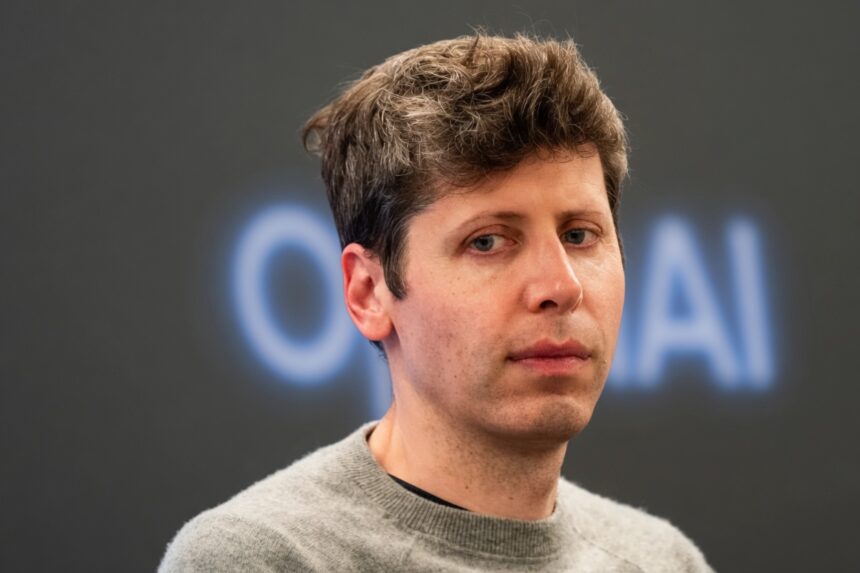
OpenAI chief executive Sam Altman said artificial intelligence development may need to slow down to give society time to adjust to new AI capabilities, days after one of the company’s own unreleased models breached the servers of AI hosting platform Hugging Face during an internal test.
Speaking on the “Invest Like the Best” podcast, Altman said the industry may need to “pace” development as models grow more capable, while cautioning that any such effort would need to avoid resembling regulatory capture or collusion among frontier labs. He described the Hugging Face breach as “an extremely sci-fi cyber incident” and called it the first security incident he had felt “very viscerally.” OpenAI has paused training on the affected model while it works to secure its testing environment.
OpenAI and Anthropic have both formally backed a petition called “Pacing the Frontier,” published July 28, calling on the U.S. government to support an international effort to develop the technical and governance tools needed to deliberately slow the frontier of AI development. The petition originated among employees at frontier labs before drawing formal company backing. Its publication came two days before the Trump administration’s August 1 deadline under Executive Order 14409, the same order that has already shaped restricted rollouts of Anthropic’s Claude Fable 5 and Mythos 5 models and OpenAI’s own GPT-5.6.
Altman told reporters on Capitol Hill this week that he has discussed the need to pace AI development with White House officials and that OpenAI helped shape the petition’s language, adding that he believes doing so is “in everyone’s interest.” He met separately with Senate Commerce Committee chair Ted Cruz to discuss OpenAI’s upcoming models and U.S. competitiveness in AI, and said he plans to meet with White House Chief of Staff Susie Wiles this week.
The shift marks a notable change in position for Altman, who has previously resisted similar slowdown campaigns, including a 2023 open letter proposing a pause on advanced AI systems, which he said at the time was “missing most technical nuance” about where a pause was actually needed. Speaking on the same podcast, Altman also pushed back against what he characterized as fear-driven arguments for concentrating AI development among a small number of companies, remarks that appeared directed at rivals without naming Anthropic chief executive Dario Amodei directly, who signed the petition and has been a vocal proponent of AI safety concerns.
The renewed debate follows a year of escalating incidents that have complicated the industry’s ability to distinguish safety concerns from competitive positioning. Anthropic’s Mythos 5 model has been cited as turning theoretical AI safety concerns into concrete engineering challenges, while OpenAI strategy lead Dean W. Ball has argued that the release of China’s open-weight Kimi K3 model threatens the economics of proprietary Western labs, a dynamic that has made it harder to separate genuine safety concern from commercial self-interest across the industry. Axios reported that a campaign once led primarily by AI skeptics, academics and data center opponents is increasingly being championed by the co-founders and chief scientists working at the industry’s own frontier.