

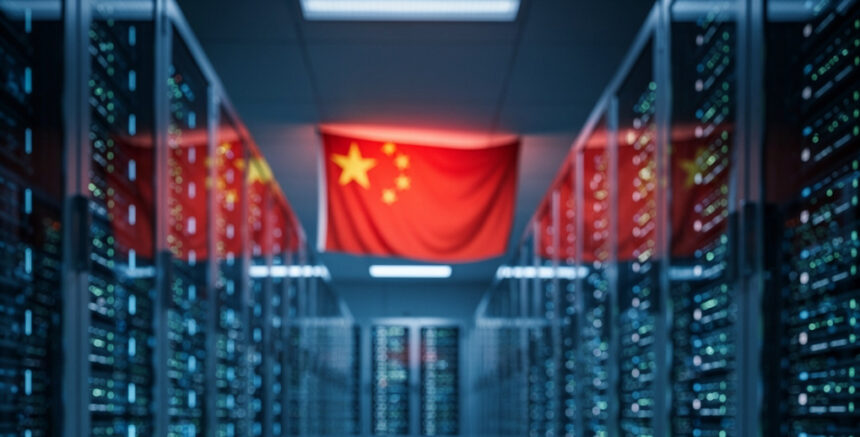
Chinese food delivery giant Meituan said Tuesday it had released and open-sourced its next-generation LongCat large language model, claiming it is the first trillion-parameter AI system trained and run entirely on a cluster of Chinese-made chips.
The model, called LongCat-2.0, carries 1.6 trillion parameters and a context window of 1 million tokens, putting it on par with DeepSeek’s flagship V4-Pro model and comparable to Google’s Gemini 3.1 Pro, according to benchmarks released by the company.
Meituan said the model was trained on a 50,000-chip domestic computing cluster, using hardware widely associated with Huawei Technologies, including its Atlas-950 SuperPods and Collective Communication Library. The company did not name its chip supplier directly.
The release matters less for its size than for what it ran on, according to industry analysts. While Chinese AI labs including DeepSeek have previously used domestic chips for inference, the lighter task of answering user queries, Meituan says LongCat-2.0 is the first model of its scale to also complete the far more demanding pre-training phase entirely on home-grown silicon, without relying on Nvidia hardware restricted under U.S. export controls.
The United States has restricted the export of advanced AI chips to China since late 2022 in an effort to slow the country’s progress on frontier artificial intelligence. Tuesday’s announcement is the clearest signal yet that Chinese companies may be able to train top-tier models without access to that hardware.
Meituan, often compared to U.S. food delivery company DoorDash, is a comparatively late entrant to China’s crowded AI sector, where it competes with DeepSeek and ByteDance’s Doubao. The company’s LongCat team was founded in 2023 and released its first model, LongCat-Flash, in September 2025.
The company has not disclosed how LongCat-2.0 will be integrated into its existing operations but has previously used earlier versions of the model to power in-app AI assistants that recommend restaurants and hotels and complete tasks such as food orders and room bookings.
Meituan made the model’s weights publicly available through Hugging Face, a move that mirrors the open-source strategy that propelled DeepSeek to global attention earlier this year. Independent benchmarking of LongCat-2.0’s performance, and verification of Meituan’s training-hardware claims, is expected from the open-source research community in the coming weeks.
What This Means for Australia
For Australian businesses, researchers and policy makers, Tuesday’s announcement is just another data point in a much larger story. That being the global AI race is no longer just about who has the smartest model, but in fact who controls the hardware beneath it.
Australia doesn’t manufacture any advanced AI chips of its own and solely relies on the U.S. technology export-control system. Which was the same system China’s LongCat-2.0 was built to route around.
That dependency was thrown into sharp relief earlier this month when a U.S. export directive cut Australian researchers, and analysts off from Anthropic’s most capable models overnight, with no warning. If Chinese firms can now train frontier-scale models entirely on domestic chips, it shows that hardware dependency on the United States isn’t a fixed feature of the AI landscape. It’s now a strategic choice that other countries are now looking to escape.
That has two implications worth watching locally.
First, it strengthens the case being made by Australian researchers and former CSIRO Data61 leadership for a genuine sovereign AI strategy, one that includes data stored on Australian soil, and compute infrastructure Australia actually controls. Right now, Australia has neither.
Second, it adds pressure to the country’s already heated debate over AI data centres. Australia is the second-largest destination for data centre investment in the world, but community and environmental groups, along with Sydney Water, have raised concerns about the energy and water demands of the AI boom. If global compute strategy is shifting toward national self-sufficiency, as China’s move suggests, Australia’s choice to host other nations’ AI infrastructure rather than build its own capability is a decision with consequences that will play out over years.
For Australian businesses using AI tools day to day, the immediate impact is minimal. LongCat-2.0 isn’t a consumer product, and it won’t change what’s available in the Australian market this week. But for anyone tracking where the next decade of AI infrastructure, and investment is heading, this is exactly the kind of story to watch.