

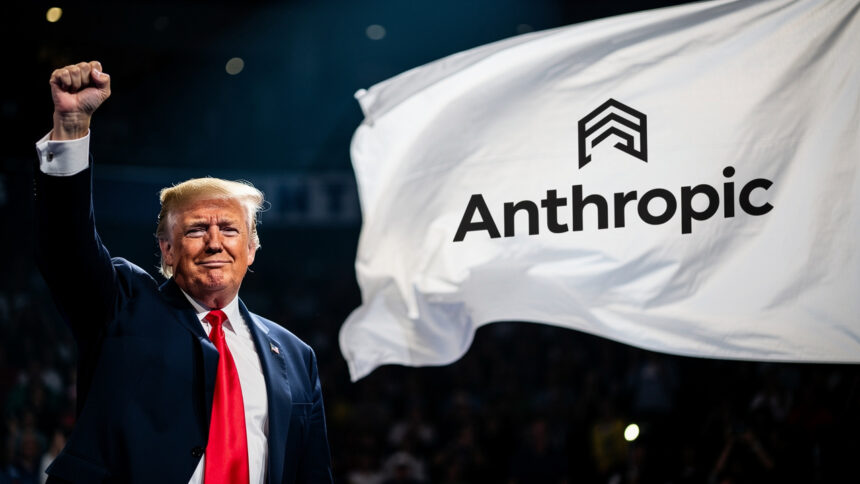
Anthropic restored global access to its Claude Fable 5 AI model Wednesday, ending a roughly 19-day suspension triggered by U.S. export controls, but warned that coding and debugging tasks will temporarily default to the older Claude Opus 4.8 model more often as a result of stricter safety measures.
The model returned to the Claude Platform, Claude, Claude Code and Claude Cowork on July 1, according to a company blog post. Access via AWS, Google Cloud and Microsoft Foundry is expected to follow.
The suspension began June 12, when the U.S. Department of Commerce cited national security authority to bar any foreign national from using Fable 5 or its more capable counterpart, Mythos 5. Anthropic said it had no reliable way to verify user nationality at commercial scale and pulled both models worldwide as a result.
The export controls followed a report from Amazon researchers, who found a technique for prompting Fable 5 to identify software vulnerabilities and, in one case, produce code demonstrating how one could be exploited.
Anthropic said it addressed the issue by retraining the classifier system that sits in front of Fable 5 and screens requests for cybersecurity, biology, chemistry and model-distillation risks. The company said the new classifier blocks the specific technique described in the Amazon report in more than 99% of cases.
When a request trips that classifier, Fable 5 does not respond directly. Instead, the request is automatically routed to Opus 4.8, and the user is notified that the fallback occurred, according to Anthropic.
The company acknowledged the tighter classifier also flags a higher share of legitimate coding and debugging requests. “The new classifier also comes at the cost of flagging benign requests more often during routine coding and debugging tasks,” Anthropic said in its post. “We’ll continue to refine this to better distinguish genuine misuse from legitimate requests and reduce false positives.”
Anthropic said internal testing found that Opus 4.8, along with competing models, could reproduce the vulnerabilities identified in the Amazon report, suggesting the underlying issue was not unique to Fable 5’s capabilities.
Mythos 5, which shares the same underlying model weights as Fable 5 but carries fewer safety guardrails, returned to a limited set of U.S. organizations cleared by the government on June 26. Anthropic said it is continuing to coordinate with the government to expand access to additional partners under its Project Glasswing program.
For Pro, Max, Team and select Enterprise plans, Fable 5 usage will count toward up to 50% of weekly usage limits through July 7, after which it will draw from usage credits, the company said.
Anthropic said it is also working with Amazon, Microsoft, Google and other Glasswing partners to develop a shared framework for assessing the severity of AI jailbreaks and coordinating industry responses to them.
What This Means Beyond U.S. Borders
The 19-day blackout was not a unique problem for the U.S. It was a global one, and it landed hardest on those who had no part in causing it.
When the Commerce Department issued its June 12 directive , it did not distinguish between American developers and everyone else. Researchers in Australia, the UK and and other allied countries to the U.S. all lost access to Fable 5 and Mythos 5 simultaneously, with no notice and no transition period. Anthropic has said plainly that it had no way to verify user nationality in real time at commercial scale, so it pulled the models for every customer worldwide rather than risk noncompliance. The people who bore the cost of that decision were ironically not the people the directive was written to target.
This is not the first time in 2026 that a U.S. policy decision has rippled outward with little regard for how it lands elsewhere. Since President Trump’s return to office, Washington’s approach to AI export controls has increasingly treated even close partners as flight risks rather than co-owners of shared technology infrastructure. Countries that host American cloud regions and buy their chips; that align themselves with American foreign policy have found themselves cut off from American AI tools without any regard to their “partnership” , a pattern that reads as anything other than a trust problem.
Although this isn’t to say that the underlying security concern was illegitimate. A model that can be prompted into producing exploit code is a real problem. Anthropic’s response, a retrained classifier rather than just a complete shutdown, suggests that the company saw it as a fixable rather than a fundamental issue. But the mechanism the U.S. government chose to address that problem swept up allied researchers and institutions with no mechanism for exemption. More importantly there was no advance warning, and no differentiated treatment for countries Washington calls partners. If that becomes the template for how the U.S. manages AI risk going forward, allied nations may increasingly ask what “ally” is actually worth to them in this new era, and start hedging accordingly.