

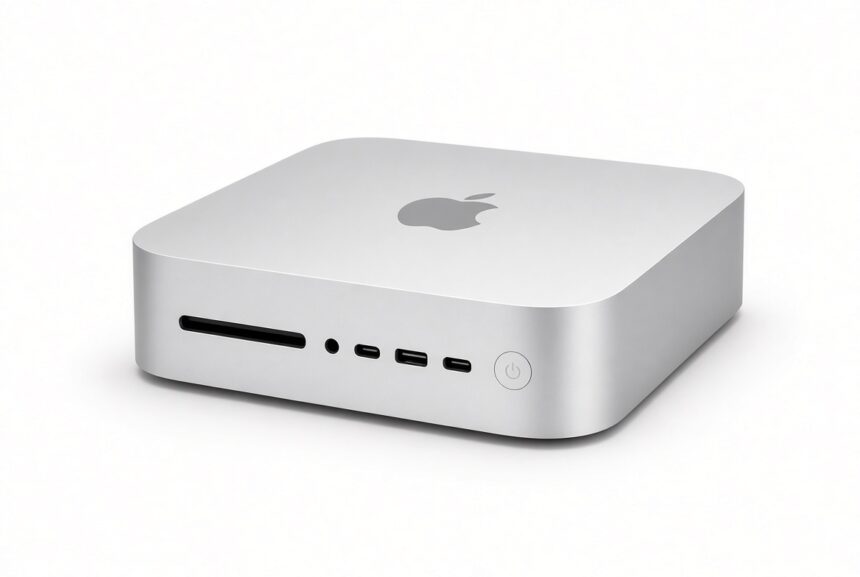
The Mac mini RAM apocalypse did not cancel the computer. It canceled the deal.
I’ll be honest with you: I used to treat the Mac mini like the one Apple product that still felt like a loophole. Tiny. Quiet with enough silicon to do real work.
The new M6 Mac mini starts at $899 with 16GB of unified memory and 256GB of storage. The M4 launched at $599 in late 2024. Apple had already shoved the old base to $799 before swapping in the M6. The M5 Pro mini now starts at $1,699. Want 24GB on the M6? That would be $200. Want 32GB? $400. Want 1TB? $500. Build a 32GB machine with 2TB and you are north of $2,200 with specs akin to a macbook with none of the things that make a MacBook worth the pricing.
I would not call the mini a flop due to the fact that people still want it. The reviews are fine. The design still looks great. And yet the machine is getting pulverized in the only way that matters for this product: it stopped being the cheap always-on box you could leave under a monitor and forget about.
Cook called the memory crunch a hundred-year flood. Apple said it had never seen a component jump this much, this fast. Data centers will pay more per bit than a designer buying a desk computer. Some estimates have racks swallowing around 70% of memory output this year. High-memory minis and Studios were quoting waits measured in months. SK Hynix has already pointed at 2027 as a worse year, not a recovery year.
Long story short, the Mac mini RAM apocalypse is what happens when the product that needed cheap memory most meets the industry that will never treat memory as cheap again.
As a founder, my reaction was complicated because I could agree with both sides. I do not think buyers are overreacting. The distrust is about the job they thought they were hiring the mini to do. I also do not think Apple invented HBM hunger or quietly decided to punish homelabs. They just took the “affordable Mac” story one price hike too far while keeping the 16GB door price that no longer proves the use case.
1. The Evidence Test: Is 16GB Proving the AI Mini, or Illustrating It?
There is a fine line between a base spec that gets you working and a base spec that exists so the headline price looks less violent.
Imagine Apple shows a keynote of a mini running local models, agents, and a dozen tabs. The chip is faster. The footage is real. Does that matter if the $899 SKU still ships 16GB and 256GB? It matters a lot. The image is illustrating a workload. The config you can actually buy on impulse is not proving it.
16GB was already tight. Apple kept it anyway. 256GB storage stayed too. The M6 maxes at 32GB, same ceiling as the last cheap mini, at a much worse sticker. Extra cores are a real upgrade. They are not evidence that the bargain desktop still exists.
If memory is functioning as proof that you can run the AI job that created the demand spike, 16GB at $899 is a creative campaign. It is not the product people queued for.
2. The Authenticity Test: Was Cheap-and-Capable Part of What You Were Selling?
One argument I cannot stand is that mini buyers “were always going to pay Pro money.” I hate to break it to you, but a lot of them chose this machine because it was the opposite of a $2,000 laptop. Headless. Small. Good enough.
That price was the value proposition. Not the Ethernet jack. Not the colorways. The deal.
If customers learned exactly how the Mac mini RAM apocalypse works, they would understand the supply math and still feel the brand promise move. Apple sold a desktop that punched above its size. Then memory became a luxury input and the punch started costing Studio-adjacent money.
You can still love the industrial design. You cannot pretend $899 for 16GB/256GB is the same agreement as $599.
3. The Substitution Test: What Do Buyers Think the Crunch Replaced?
This is the emotionally charged part, and it is less about benchmarks than about what people thought was disposable.
People do not hate paying more when they get more. They hate paying more, waiting 16 weeks, and being told the useful RAM config is the scarce SKU.
If you tell a customer the M6 is faster per watt, most will shrug and refresh the store. If you tell them the RAM they need is being bid away by training clusters, and the upgrade they need is $400 before they have bought a display, they start looking at used M4s, mini PCs, and towers that still take sticks.
Two questions matter:
- What do buyers need to know before September 22 units land?
- Can Apple get ahead of “the bargain desktop is now a memory tax,” or only ship into it?
Base units are easier to find than they were in spring. The configs that run local models are not. A plentiful 16GB mini and an unobtainable 48GB mini are not the same computer. Pretending they are is how you get the comments section.
4. The Cost-of-Reality Test: What Are You Buying by Staying Soldered?
This is the question that bruises the homelab people.
Can you justify Apple’s soldered memory tax when the reason you wanted the mini was local models that drink RAM? Can you justify a quarter-year wait for 64GB when a tower would have let you add sticks next week?
Here are six questions that make loyalty hard:
- Did avoiding a generic mini PC materially improve the workflow?
- Did 16GB portray the AI use case honestly?
- Did the M6 create noticeably more capability at the price people actually pay?
- Did higher prices reduce demand, or just shove it onto the used market?
- Did soldered unified memory still make sense when memory is the scarce input?
- Did the mini still reinforce “cheap powerful Mac,” or only “small expensive Mac”?
If the answers are ugly, you are paying to stay in the ecosystem and calling it a workstation decision.
Let’s shift from morals to math. $599 to $899 is a 50% hike from the M4 launch price. $200 to go 16GB to 24GB. $400 to reach 32GB. $500 to reach 1TB. A 2TB SSD bump can cost more than the whole base computer. That is not a rounding error. That is the memory market sitting on the SKU.
Apple can still sell every unit it can build. Doomed here does not mean unsold. It means the mini’s job, the always-on cheap AI brick, got arbitraged away by people who will pay more for the same chips in a rack.
Money spent pretending $899 is still the people’s Mac cannot also be spent buying the RAM that made the people’s Mac useful.
It’s not Apple versus AI. It’s whether the bargain still exists.
At the end of the day, the thing buyers can hold Apple to is simple. If you sell a small powerful desktop, ship the memory that makes it powerful, at a price that makes it small.
I am not suggesting Apple should lose money so hobbyists can run models in a closet. I am not suggesting the M6 is a bad chip. The Mac mini RAM apocalypse is what happens when the story you sold and the component you need stop being the same product.
You can still buy one on September 22. You should just stop calling it the affordable Mac.