

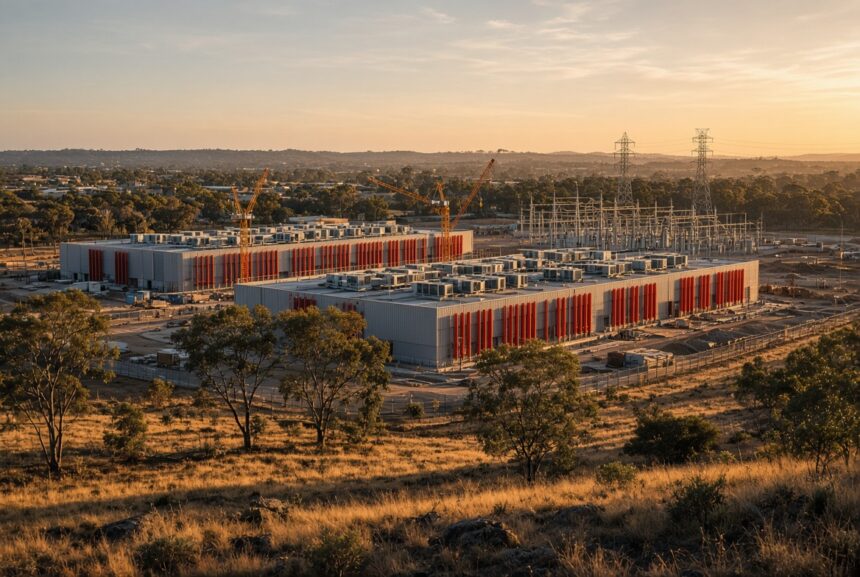
Nvidia Corp. said last week it wants Australian partners to host up to 2 gigawatts of artificial intelligence computing by 2027, a build-out that would more than double the country’s existing data-center load. The announcement landed as Canberra prepares national rules on power and water that will not apply to many warehouses already approved.
The Santa Clara, California, chipmaker named eight Australian operators: Firmus, Sharon AI, IREN, Megaport, ResetData, CDC, NEXTDC and AirTrunk. Their sites would be built around Nvidia’s DSX “AI factory” stack.
Estimates of what is already running do not match. ABC News, using March figures, counted 162 operating centers totaling 1.5 gigawatts. Lobby group Data Centres Australia, citing analyst DC Byte, puts current capacity at about 1.6 gigawatts. A JLL briefing cited by ACS Information Age used 1.2 gigawatts for the operating base and a much larger planned pipeline.
The queue is bigger than the fleet. ABC reported 27 approved but unbuilt projects totaling at least 3.38 gigawatts. Other published pipelines range from about 6 gigawatts to more than 16, depending on what analysts count as firm. Not every announced hall will be built.
NEXTDC’s S4 campus at Horsley Park, on Sydney’s western fringe, is one of the large sites already moving. New South Wales granted State Significant Development consent on Dec. 24, 2025, for a data center with 294 megawatts of power consumption. NEXTDC and trade press later describe a 350-megawatt facility. Construction started in 2026, with completion aimed at mid-2027. IREN is planning an 800-megawatt campus at Bundey in South Australia. CDC says it already runs more than 550 megawatts across Australia and New Zealand and has another 800 megawatts under construction.
Prime Minister Anthony Albanese said in July that Australia can “set the terms” and “determine AI’s social licence.” His government created an Office of AI inside the Department of the Prime Minister and Cabinet and has promised legislation in early 2027. Draft standards would require large new centers to underwrite fresh generation, pay their own grid connections so household bills do not rise, and cut water use. States would keep planning control.
The rules, officials say, will not be retrospective. “You can’t retrofit,” Albanese told ABC Radio Sydney on July 16. He said many centers already under construction tend to be smaller ones.
Climate Council chief executive Amanda McKenzie said most projects in a large national pipeline had not broken ground and urged the government to apply the new conditions to schemes already in the planning system, not only to proposals filed after the law passes. Greens Sen. Sarah Hanson-Young has called for a moratorium and for the standards to cover sites already approved, arguing otherwise the rules will miss the largest halls now in the queue.
Most planned load sits in New South Wales and Victoria. JLL has described a pipeline in the order of $155 billion and said warehouse rents in Melbourne’s west and outer western Sydney could nearly double within two years. Commonwealth Bank has used a central estimate of about $150 billion of build by 2030. Goodman’s Project Apollo, north of Sydney, has drawn state conditions on water and energy. Amazon Web Services, Microsoft, AirTrunk and Stockland are among other names attached to unbuilt or expanding campuses.
Residents are organizing. Jack Tollefsen, a software engineer near Horsley Park, said his worry is “the environmental impact, the impact it has on the ecosystem, the native wildlife in the area.” He started a petition and wants closed-loop cooling so the campus does not draw drinking water. NEXTDC’s Footscray site in Melbourne’s inner west has drawn complaints about noise and light. A Victorian Greens bid for a moratorium on hyperscale approvals failed in the state Parliament.
Industry groups say they cannot obey a rule that does not yet exist. “Members will continue to meet those requirements until the new rules are in force, but they cannot comply with something that isn’t yet established or even articulated,” said Belinda Dennett, chief executive of Data Centres Australia. Lawyer Kate Muller, who advises energy and infrastructure clients, said the debate has not scared capital off. “We certainly haven’t seen that in our practice,” she said.
Nvidia framed the Australian program as local innovation plus export compute. “Expanding capacity in Australia will enable local innovators to develop models, applications and agents while supporting additional power generation projects to support regional and global demand for AI compute,” the company said. The Australian Financial Review reported that Nvidia’s planned chips in Australia next year would use more electricity than all of today’s centers combined, a comparison drawn from the 2-gigawatt target rather than a grid-operator forecast. Bloomberg reported AirTrunk has seen stronger interest from Google, Apple, Meta, Amazon and Microsoft over the past six to eight months, drawn by a relatively green grid and proximity to Asia.
Two federal inquiries into AI and data centers are due later this year. National Cabinet has discussed minimum standards. Hydro Tasmania has been weighing a large power request for an AI campus. The Department of Industry, Science and Resources said the government wants the investment “sustainable and aligned with our national interests.”