


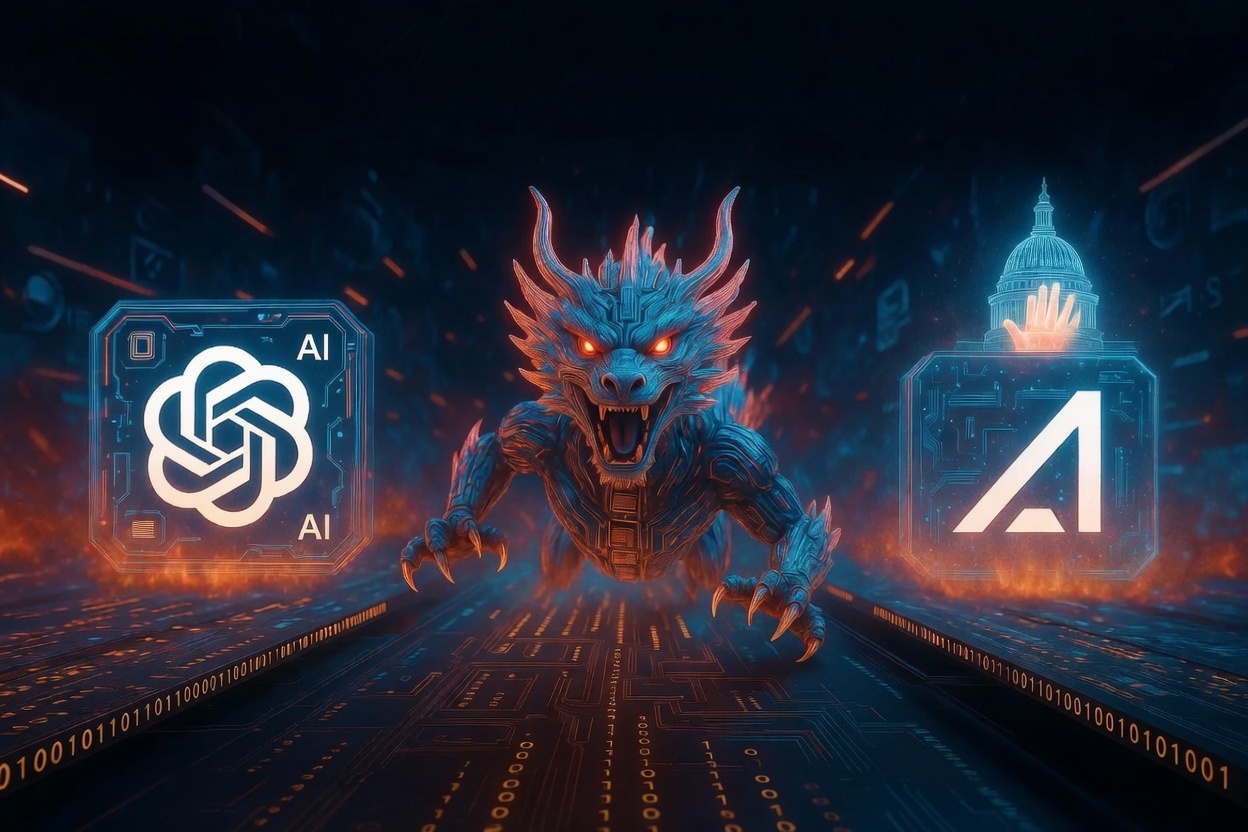
A Chinese open-source AI model has pulled within a percentage point of America’s best, at a fraction of the cost, and it arrived the day after Washington forced its closest rivals off the market. For Australia, the timing could not be more uncomfortable.
A Chinese artificial intelligence startup has released an open-source model that sits within a percentage point of Anthropic’s best system on a key benchmark. It costs roughly a fifth of the price to run, and arrived on the market one day after the United States government forced Anthropic to pull its most advanced models from global users.
Zhipu AI, the Beijing-based company also known as Z dot ai released its GLM-5.2 model on June 13, hours after a U.S. Commerce Department directive gave Anthropic fewer than 48 hours to disable worldwide access to its Fable 5 and Mythos 5 models. By June 16, Zhipu had published the full model weights under an MIT open-source licence, meaning any developer, company or government in the world could download it, run it on their own servers, and use it however they chose, with no American company or government able to take it away.
“GLM 5.2 is the first open-source model where it is really competitive with some of these closed-source frontier models.”
— Gabe Pereyra, co-founder of Harvey, speaking to CNBC, June 26, 2026
The benchmark results that followed stunned the AI industry. GLM-5.2 scored 81.0 on Terminal-Bench 2.1, a closely watched agentic evaluation, against Anthropic Opus 4.8’s score of 85.0, a gap of four points. On MCP-Atlas, a tool-use benchmark, it outscored Opus 4.8 outright. On Artificial Analysis’ broader intelligence index, it placed fourth globally, above Claude Opus 4.6. On Code Arena’s front-end coding leaderboard, it ranked second in the world, trailing only Anthropic’s Fable 5, which is no longer publicly accessible.
The model runs 750 billion parameters using a mixture-of-experts architecture, with a one-million-token context window processing at 300 tokens per second. Its API costs $1.40 per million input tokens and $4.40 per million output tokens. Anthropic’s comparable Opus 4.8 costs $5 per million input tokens and $25 per million output tokens.
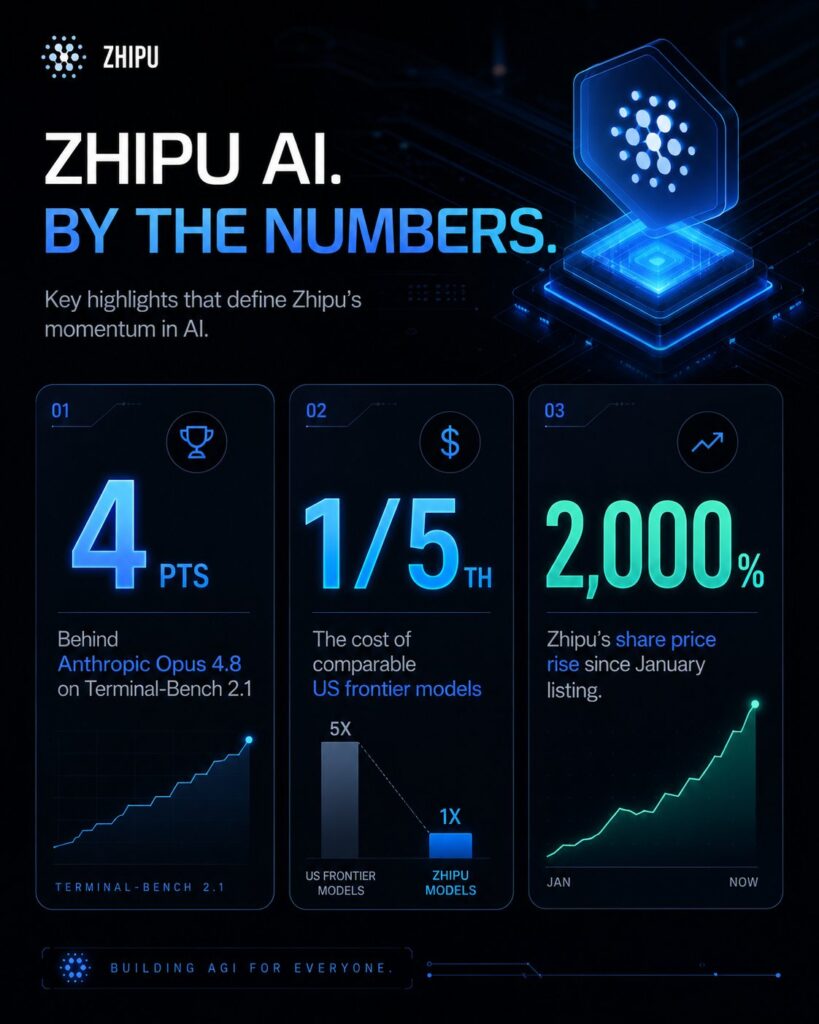
nvestor reaction in Hong Kong has been immediate. Zhipu’s shares surged more than 42% on Monday, pushing its market capitalisation above 1 trillion Hong Kong dollars, roughly $128 billion U.S., in what one analyst described as a structural rerating of where China sits in the global AI race. The stock has climbed more than 2,000% since its Hong Kong debut in January.
The broader context matters. Two of the three US frontier AI labs, Anthropic and OpenAI, are now operating under government model-release controls. OpenAI announced Friday that its new GPT-5.6 series, including its flagship Sol model, will initially be available only to a small group of Trump-administration-approved partners. Google DeepMind is expected to face similar requirements under a June 2 executive order framework. Meanwhile, eight Chinese AI labs released more open-weight models in 2026 than the rest of the world combined, according to analysis cited by industry observers.
The irony is not lost on critics. US chip export controls, imposed to slow China’s AI development by cutting off access to advanced Nvidia hardware, forced Chinese labs to optimise their model architectures for efficiency. That constraint-driven innovation is now the source of their competitive advantage. Zhipu’s GLM-5.2 was adapted to run on Huawei Ascend domestic chip clusters, meaning it is completely independent of American hardware.
Canada and France, whose leaders criticised over-reliance on US-controlled AI infrastructure at a G7 summit last week in Evian-les-Bains, France, are among the allies most alarmed by the pattern. With US frontier models now gated by government approval, the question facing every US-aligned country is whether Chinese open-source alternatives will step into the gap.
What this means for Australia
Australia finds itself at the sharpest edge of this tension. It is one of the United States’ closest security partners, a founding member of AUKUS, and a country that has staked significant strategic and economic credibility on aligning with Washington in the US-China technology contest. It is also a country with no sovereign AI capability worth speaking of, no binding AI legislation, and a critical minerals sector that still sends roughly 95% of its lithium to China for processing.
The immediate problem is access. When the US Commerce Department ordered Anthropic to disable Fable 5 and Mythos 5 globally on June 12, Australian researchers and businesses lost access alongside the adversaries the measure was designed to target. When OpenAI restricted GPT-5.6 to government-approved partners on June 26, Australia was not on the list. For a country with no domestic frontier AI models of its own, being caught in the crossfire of US export controls twice in a fortnight is not a minor inconvenience, quite the contrary in-fact.
The Australian Strategic Policy Institute has repeatedly called for Canberra to secure preferential access to US AI capabilities under AUKUS Pillar Two, the advanced technology cooperation pillar that already covers AI, cyber and autonomous systems. That argument is more urgent now. At the G7 summit in France last week, allied leaders warned of the risks of over-dependence on US-controlled AI infrastructure. Although Australia was not in the room for this, but the warning remains the same.
For Australian businesses watching their AI budgets strain, swapping from US AI dependence to the open source Chinese equivalent is an attractive option. But it comes with significant risks. Z dot ai’s cloud API is subject to China’s National Intelligence Law, which can compel the company to hand data to Chinese authorities on request.
US House lawmakers opened a formal inquiry in May into cybersecurity risks posed by Chinese-origin AI models deployed near critical infrastructure, naming Zhipu among the companies under review. Australia banned DeepSeek from government devices in February. A blanket approach to every Chinese model that follows will become harder to sustain as the capability and cost gap between US and Chinese AI continues to narrow.
The deeper question is one ASPI analysts have been raising for months: Australia cannot continue responding to each new development after the fact. Banning tools once they are already embedded is already too late. The country needs a coherent AI strategy that treats AI infrastructure as critical infrastructure, develops sovereign capability through trusted partners, and most importantly establishes clear rules about which systems can be used in which contexts, before a crisis forces the decision.
Zhipu’s GLM-5.2 is not, by itself, a turning point. But it arrives at a moment when the US AI lead is narrowing.