


The US company says Alibaba used 25,000 fake accounts to run nearly 29 million interactions with its Claude models in a coordinated attempt to copy its most advanced AI capabilities. For Australia, caught between two superpowers racing for AI dominance, the implications run deep.
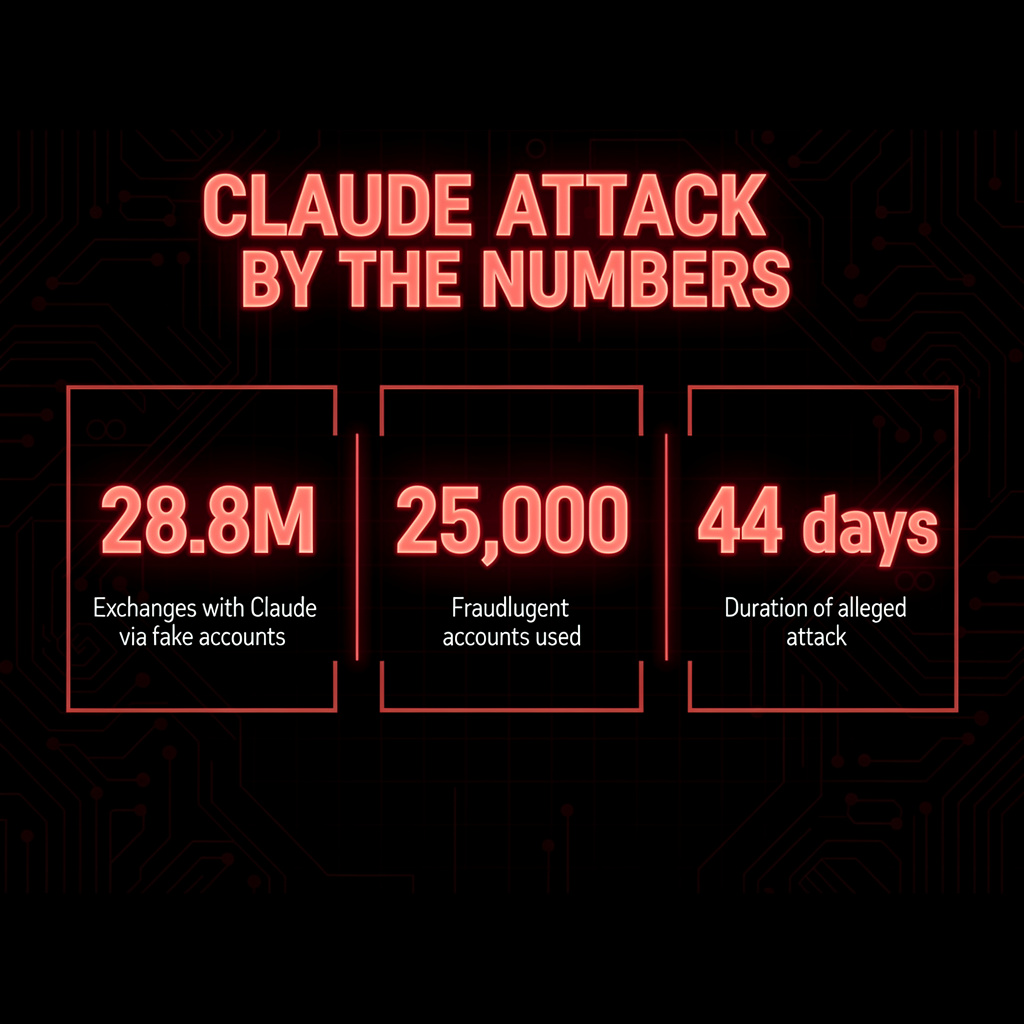
In a letter dated June 10 and addressed to the U.S. Senate Banking Committee, Anthropic alleged that operators linked to Alibaba and its AI research division, Alibaba Qwen, generated more than 28.8 million exchanges with Claude models between April 22 and June 5, routing them through roughly 25,000 fraudulent accounts specifically designed to extract the system’s most advanced reasoning and software engineering capabilities.
“These distillation attacks are carried out illicitly, systematically, and at an industrial scale to harvest US AI capabilities across frontier labs and repackage them as their own.” — Anthropic, letter to the U.S. Senate Banking Committee, June 10, 2026
The technique Anthropic describes is known as adversarial distillation. In standard machine learning practice, a smaller, less capable model is trained using outputs from a larger, more powerful one, a widely accepted method used internally by almost every major AI company, including Anthropic itself. What Alibaba allegedly did, however, was weaponize that process against a competitor, using the fraudulent accounts to flood Claude with carefully designed prompts intended to expose the model’s deepest capabilities, then harvesting those responses to train a rival system at a fraction of the cost of original research and development.
Anthropic said the campaign was not opportunistic. It described it as a coordinated effort targeting specific capabilities in software engineering and autonomous task execution, the precise areas where Claude’s most commercially valuable and strategically sensitive abilities sit.
This was not the first time Anthropic had raised the alarm. In February, the company disclosed what it described as industrial-scale distillation campaigns by three other Chinese AI labs: DeepSeek, Moonshot and MiniMax, which together generated more than 16 million exchanges through roughly 24,000 fake accounts. The Alibaba campaign, if Anthropic’s account is accurate, dwarfed all of them.
Alibaba had not publicly responded to the allegations as of Thursday. Its shares fell roughly 3% following the news.
The political consequences have been swift. Two U.S. senators, Bill Hagerty, a Republican from Tennessee, and Andy Kim, a Democrat from New Jersey, moved to add an amendment to defence legislation that would blacklist or sanction any entity found conducting adversarial distillation campaigns against American AI companies. Two days after Anthropic sent the letter, the U.S. Commerce Department issued export control restrictions requiring Anthropic to suspend global access to its two most advanced models, Fable 5 and Mythos 5, over concerns they could be accessed by military and intelligence entities in China and other countries of concern. The restrictions applied globally, cutting off users in allied nations alongside adversaries.
Anthropic has called for coordinated action from government agencies, cloud providers and AI companies to detect and block distillation campaigns, and has urged Congress to strengthen export controls and establish legal penalties for capability extraction.
The Pentagon separately added Alibaba to its list of Chinese military companies, a designation Alibaba is contesting.
What this means for Australia
For Australia, the Anthropic-Alibaba dispute is not a distant argument between two foreign superpowers. It sits directly at the intersection of two of the country’s most pressing strategic tensions: its deep economic relationship with China and its deepening security commitments to the United States under AUKUS.
Alibaba is one of the most widely used technology platforms in Australia. Through AliExpress, Alibaba dot com and its cloud services, the company has significant reach into Australian homes and businesses. While Alibaba closed its Sydney data centres in 2024, Australian businesses continue to access its cloud infrastructure through Singapore-based servers, meaning Australian commercial data remains within its ecosystem.
At the same time, the U.S. export restrictions triggered by Anthropic’s letter have already affected Australian users directly. When the Commerce Department ordered Anthropic to suspend access to its Fable 5 and Mythos 5 models globally, Australian researchers, developers and businesses using those tools lost access alongside the adversaries the restrictions were designed to target.
That tension sits at the heart of a broader problem Australia has not yet resolved. The Australian Strategic Policy Institute noted this week that the restrictions expose a vulnerability in Australia’s position: as the US tightens its grip on frontier AI access, Australian organisations relying on American AI tools face collateral disruption with little recourse. ASPI has called for Australia to deepen AI cooperation with the United States and other like-minded partners under AUKUS Pillar Two to secure preferential access to advanced AI capabilities before that access is further constrained.
The deeper issue is one of strategic positioning. The Stanford 2026 AI Index published this month found that the gap between the leading American and Chinese AI models has narrowed to just 2.7%. If China succeeds in closing that gap through methods like the one Anthropic alleges, Australia will face a future in which the AI systems underpinning its economy, defence and public services are being shaped by a technology race it is watching from the sidelines rather than participating in.
How Canberra responds, whether through legislation, deeper alliance commitments or investment in sovereign AI capability, may prove to be one of the defining technology policy questions of the decade.