



The tech giant disclosed in its annual filing that artificial intelligence deployment directly drove one of the largest workforce reductions in its history.
Oracle eliminated 21,000 jobs over the past 12 months, nearly 13% of its global workforce. It said in a regulatory filing this week that the rollout of artificial intelligence across its operations was directly responsible for the cuts, making it one of the first major technology companies to say so explicitly.
The disclosure, buried in Oracle’s annual 10-K filing submitted to the Securities and Exchange Commission on June 22, brought the company’s total headcount to 141,000 full-time employees as of May 31, down from approximately 162,000 a year earlier.
“The adoption and deployment of AI technologies across our operations have resulted, and may continue to result, in reductions to our workforce.” — Oracle, fiscal 2026 annual filing
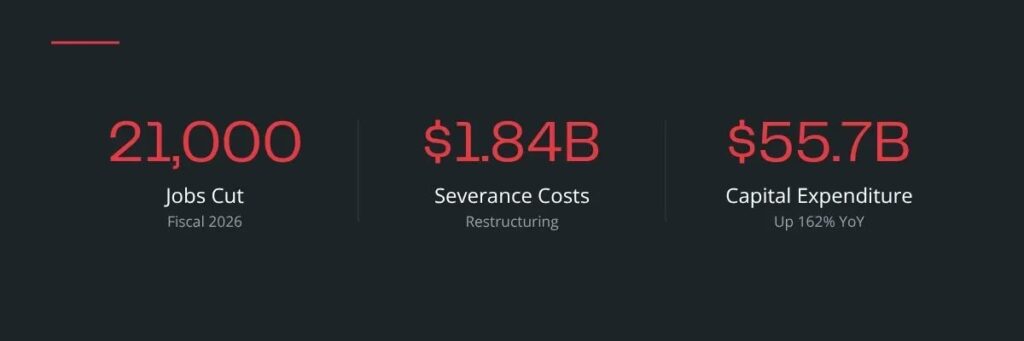
The company reported negative free cash flow of $23.7 billion in fiscal 2026, a figure that would have been unthinkable for Oracle just two years ago.
The bet underpinning this spending is substantial. Oracle signed a five-year, $300 billion deal to supply data center capacity to OpenAI under Project Stargate and holds additional agreements with Meta. Its remaining performance obligations ballooned to $638 billion, up from $138 billion the prior year. More than half of that backlog is reportedly tied to OpenAI.
To finance the buildout, Oracle has raised $30 billion in debt and is preparing to issue up to $20 billion in new stock. The company expects total capital expenditure for fiscal 2027 to reach roughly $70 billion.
Oracle is not alone. According to layoffs tracking site Layoffs.fyi, cited by Reuters, 196 technology companies have cut more than 119,800 employees so far in 2026.
Meta, Google, Microsoft, and Amazon have all announced significant workforce reductions this year, and the four companies combined are expected to spend roughly $725 billion on AI-related expenses in 2026 alone.
For workers, the experience was jarring. On March 31, thousands of Oracle employees across the United States, India, Canada, and other countries received termination emails at 6 a.m. local time from “Oracle Leadership,” informing them their roles had been eliminated effective immediately. The severance package, four weeks of base salary for the first year of service plus one additional week per subsequent year, drew criticism as less generous than packages offered by rival tech firms.
The cuts hit hard in India, where Oracle employs tens of thousands across offices in Bengaluru, Hyderabad, Pune, Mumbai, Chennai, Noida, and Gurugram. The company has not disclosed country-specific figures, but reports of rescinded campus job offers added to concerns in the country’s technology sector.
Oracle’s stock fell roughly 1% Tuesday amid a broader global technology selloff and is down more than 10% since the start of the year.
For the investor, the story is not entirely bad news. Oracle’s $638 billion contract backlog, larger than its entire market capitalization, suggests the company’s gamble on AI infrastructure could pay off if cloud revenue arrives on schedule.
What this means for Australia
Oracle’s candour lands differently when you consider what is already happening closer to home. When Oracle conducted its mass layoffs in April, the company declined to say whether any Australian roles were affected. But the broader picture is hard to ignore.
Australian tech firms have cut 4,450 workers so far in 2026, with every single layoff attributed to AI, according to an analysis by RationalFX data analyst Alan Cohen. Australia now ranks second globally for tech job losses, and Sydney sits third among cities worldwide for the sheer number of roles eliminated, behind only San Francisco and Seattle.
Homegrown companies are not exempt. Atlassian announced plans to cut roughly 1,600 jobs, around 10% of its workforce, to sharpen its AI-driven strategy, while WiseTech Global cut 30% of its staff.
At the same time, Oracle has been deepening its Australian footprint on the investment side. In March, the company launched an AI Customer Excellence Centre in Sydney, positioning it as a regional hub for AI adoption across Australia and Oceania. The message from Oracle to Australian businesses, in other words, is: buy our AI tools, even as those same tools are eliminating thousands of jobs globally.
A Deloitte Access Economics report published this month identifies more than 82 occupations vulnerable to AI disruption in Australia, with tech roles including software programmers, database administrators, ICT trainers and test engineers among those most at risk.
This story is, in many ways, a preview of things to come. Oracle, a company that once needed 162,000 people to run now believes it can do the same work with 21,000 fewer. Whether Australian workers and policymakers are prepared for that logic to arrive at scale here is a question that can no longer wait.